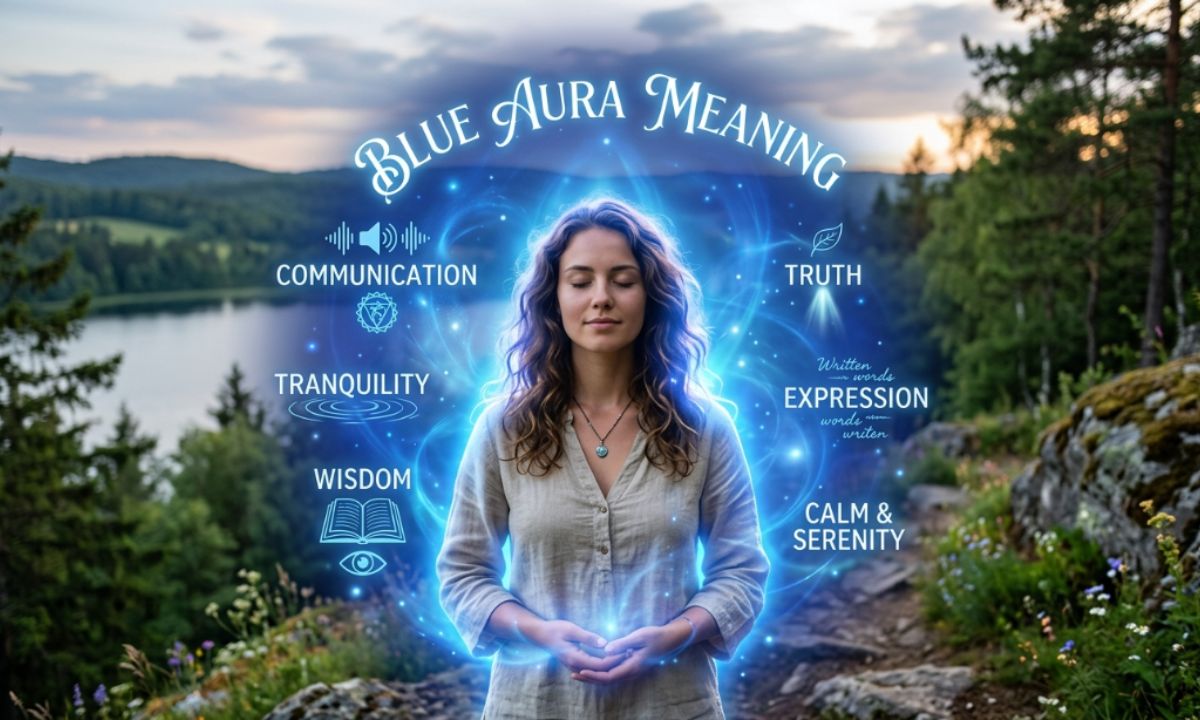
Have you ever felt calm just being near someone? That calm feeling might come from their aura. Blue auras are known for peace and honesty.
A blue aura shows up around calm, thoughtful people. It often means clear communication and inner peace. People with this aura tend to speak the truth kindly.
This guide explains blue aura meaning in simple terms. You’ll learn what different shades of blue mean. You’ll also see how it shows up in love, work, and daily life.
Why People Search for Blue Aura Meaning
There are a few common reasons someone ends up researching blue aura meaning:
- They attended an aura photography session (using Kirlian photography or similar aura camera technology) and got a result showing blue.
- An intuitive, energy healer, or psychic told them they have a blue aura.
- They practice meditation, energy work, or chakra healing and want to understand color symbolism more deeply.
- They’re curious about a friend, partner, or family member who seems to radiate a calm, communicative, “blue” energy.
- They’re interested in color psychology and how it overlaps with spiritual traditions.
Whatever brought you here, this guide will walk you through the full picture — from the general symbolism of blue in aura reading, to specific shades, to how a blue aura might influence the way someone loves, communicates, and grows spiritually.
How Aura Colors Are Believed to Work
Before diving into the specifics of blue, it helps to understand the basic framework aura readers use.
In most aura traditions, the human energy field is thought to have several layers, and different colors can appear depending on someone’s emotional state, personality, health, and spiritual development. Some practitioners believe a person has one dominant, relatively stable “life color” that reflects their core personality, alongside secondary colors that shift day to day based on mood or circumstance.
Aura colors are also frequently linked to the seven main chakras, the energy centers described in yogic and Ayurvedic traditions. Blue is associated with the throat chakra (Vishuddha), which governs communication, self-expression, and truth-telling. This is one reason blue auras are so consistently tied to traits like honesty, clear communication, and calm wisdom across different spiritual systems.
Understanding this chakra connection makes the rest of this guide easier to follow, since many of the personality traits and meanings associated with blue aura come directly from throat chakra symbolism.
What This Guide Covers
Below, you’ll find a full breakdown of blue aura meaning, organized so you can jump to exactly what you’re looking for:
- The core meaning of a blue aura and what it suggests about a person
- How blue aura relates to spirituality and subtle energy
- What it means when blue appears alongside green
- The specific meaning of light blue versus dark blue auras
- Whether a blue aura can ever be interpreted negatively
- Blue aura personality traits in depth
- How blue auras show up in love and relationships
- The connection between blue aura and emotional or mental well-being
- What a blue aura reveals about communication style
- A shade-by-shade breakdown of blue aura variations
- Whether having a blue aura signals spiritual growth
- How blue compares to other well-known aura colors
- Practical ways to recognize a blue aura in yourself
- A final, grounded look at what it truly means to have a blue aura
Also Read This:MYF Meaning in Text: What It Means in Chat, Snapchat & Social Media (2026)
What Does a Blue Aura Mean?
A blue aura is generally described as a sign of a calm, communicative, and emotionally intelligent person. In most aura interpretation systems, blue represents peace, truth, trust, and clear self-expression.
People said to have a naturally blue aura are often described as:
- Calm under pressure
- Thoughtful communicators
- Trustworthy and loyal
- Intuitive and perceptive
- Naturally soothing to be around
Because blue is a cool color often linked to the sky and ocean, it’s frequently associated with vastness, depth, and stillness. In aura reading, this translates into a personality that values honesty, seeks harmony, and prefers calm, considered responses over impulsive reactions.
Quick answer for snippet purposes: A blue aura typically symbolizes calmness, clear communication, honesty, and emotional balance. It’s often linked to the throat chakra and is considered one of the more peaceful, trustworthy aura colors in most spiritual traditions.
It’s worth noting that “blue aura” isn’t a single, fixed meaning — the shade, brightness, and clarity of the blue all shape the interpretation, which is exactly why the rest of this article breaks things down by shade and context.
Blue Aura Meaning in Spirituality and Energy
In spiritual and energy-healing traditions, blue is considered one of the more “evolved” or refined aura colors, often associated with a person who has done meaningful inner work or who naturally leans toward introspection and wisdom.
Blue and the Throat Chakra
The throat chakra governs how we speak our truth, set boundaries, and express our inner world outwardly. A strong blue presence in the aura is often interpreted as a sign that this energy center is active and balanced, meaning the person communicates clearly, listens well, and isn’t afraid of honest conversation.
Blue as a Symbol of Trust and Peace
Across many cultures, blue is symbolically tied to trust, loyalty, wisdom, and stability — think of phrases like “true blue” in English. In aura work, this same symbolism carries through: a blue aura is often read as a sign of someone others instinctively trust with secrets, decisions, or emotional support.
Blue and Higher Awareness
Some aura traditions place blue on a spectrum that moves toward higher states of consciousness, with colors like indigo and violet representing even deeper spiritual attunement. In this framework, blue is often seen as a bridge — a color that reflects someone who is emotionally settled enough to begin exploring deeper spiritual or philosophical questions.
green and blue aura meaning
When green and blue appear together in an aura — sometimes described as a teal, turquoise, or blue-green aura — it’s typically interpreted as a blend of two energies: the emotional healing and growth associated with green, and the calm communication associated with blue.
People with a green-and-blue aura combination are often described as:
- Natural healers or caregivers who also communicate with clarity and honesty
- Empathetic listeners who are good at helping others work through problems
- Balanced between heart-centered compassion (green, heart chakra) and expressive truth-telling (blue, throat chakra)
- Drawn to careers or roles involving counseling, teaching, healthcare, coaching, or creative communication
This combination is sometimes associated with people who are naturally suited to roles where both empathy and clear expression matter — therapists, teachers, nurses, mediators, and creative professionals who tell emotionally resonant stories.
If the teal or turquoise shade is especially bright and vivid, it’s often read as a particularly strong sign of someone who heals through communication — someone whose words themselves have a calming, restorative effect on others.
What Does a Light Blue Aura Represent?
A light blue aura is generally associated with gentleness, serenity, and a peaceful, easygoing nature. People with this shade are often described as calm, approachable, and naturally soothing to be around, similar to a quiet, clear sky.
Common traits linked to a light blue aura include:
- Gentle, non-confrontational communication style
- A calming presence that puts others at ease
- Strong intuition, often expressed quietly rather than loudly
- A preference for peace and harmony over conflict
- Sensitivity to the emotional tone of a room
Light blue is often considered one of the more “youthful” or open shades of blue — sometimes associated with a still-developing sense of self-expression, or with someone early in their journey toward more confident communication. It doesn’t mean less mature; it often simply reflects a softer, more delicate way of engaging with the world.
what does a light blue aura mean
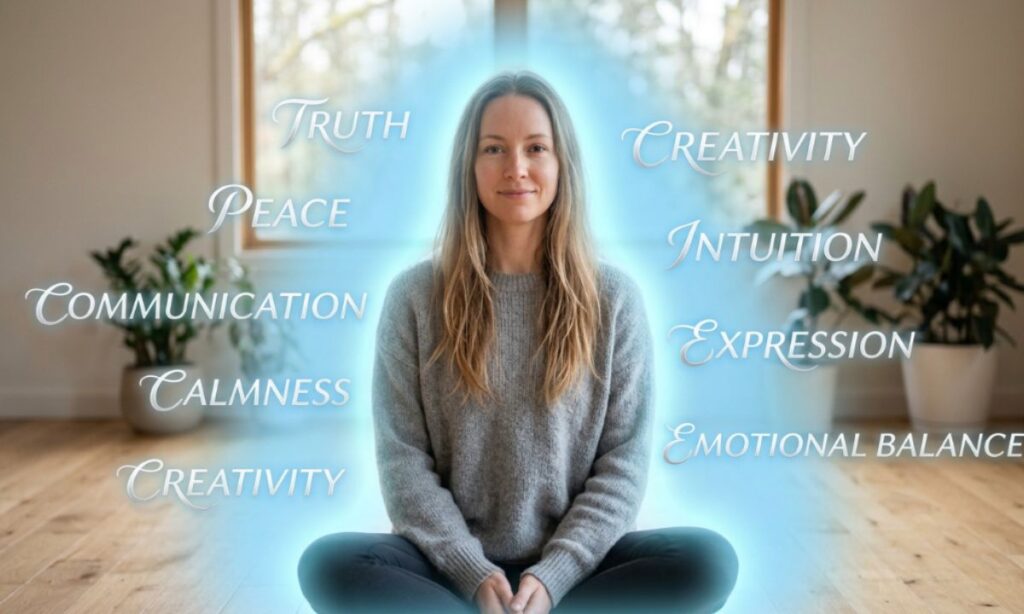
To directly answer this common variation of the question: a light blue aura means gentle, calm, and open energy, often associated with kindness, quiet intuition, and a peaceful approach to communication and relationships.
People often ask this because they’re comparing a lighter shade to a deeper, more saturated blue. In short:
- Light blue → softer, gentler, more receptive energy
- Deeper or brighter blue → more confident, decisive communication and stronger personal boundaries
Neither shade is “better” than the other. They simply reflect different expressions of the same core blue-aura qualities: honesty, calm, and clear self-expression.
What Does a Dark Blue Aura Mean?
A dark blue aura is often associated with deep intuition, strong inner wisdom, and a highly perceptive nature. This shade tends to be linked with people who think deeply, trust their instincts, and often “know things” before they can fully explain why.
Traits commonly associated with a dark blue aura include:
- Strong intuitive or even psychic sensitivity, in spiritual traditions
- A deep, reflective inner world
- Comfort with solitude and quiet introspection
- Strong personal convictions and a clear sense of right and wrong
- A tendency to observe carefully before speaking
Dark blue sits closer to indigo on the color spectrum, and in many aura systems indigo is associated with heightened intuition, spiritual insight, and even prophetic or visionary qualities. A dark blue aura is sometimes seen as a step toward that indigo energy — someone whose inner wisdom is developing into a more expansive spiritual awareness.
Table: Light Blue vs. Dark Blue Aura at a Glance
| Aspect | Light Blue Aura | Dark Blue Aura |
| General energy | Gentle, soft, open | Deep, intense, reflective |
| Communication style | Soothing, easygoing | Thoughtful, deliberate |
| Core strength | Putting others at ease | Intuitive insight |
| Common association | Emerging self-expression | Developed inner wisdom |
| Social tendency | Warm and approachable | Reflective, values solitude |
Blue aura meaning negative
Like every aura color, blue has a “shadow side” — a set of traits that can emerge when the energy is imbalanced, blocked, or expressed in an unhealthy way. A negative or imbalanced blue aura reading doesn’t mean someone is a bad person; it typically reflects an area of growth.
Common negative or challenging expressions of blue aura energy include:
- Bottling up emotions: Since blue governs communication, a blocked throat chakra can show up as difficulty expressing feelings, even though the person feels them deeply.
- Over-controlled or detached communication: Sometimes a person with blue energy can seem overly reserved, cold, or emotionally distant, especially under stress.
- People-pleasing: A desire for peace and harmony can tip into avoiding necessary conflict or difficult conversations.
- Overthinking: The reflective nature of blue energy can turn into rumination, anxiety, or excessive self-doubt when out of balance.
- Muddy or murky blue tones: In many aura-reading traditions, a clear, bright blue is read positively, while a dull, greyish, or muddy blue may be interpreted as a sign of suppressed emotion, stress, or unresolved communication issues.
If someone associates their blue aura with these more difficult traits, aura practitioners often suggest throat chakra work — such as journaling, singing, honest conversations, or simply practicing speaking up in small, safe situations — to help restore that clear, confident blue energy.
Blue Aura Personality Traits
People described as having a blue aura tend to share a recognizable set of personality traits, rooted in calm communication and emotional steadiness.
Common blue aura personality traits include:
- Honest and direct, but kind: They tend to say what they mean without being harsh.
- Naturally calming presence: Friends often go to them to “talk things through” because they stay level-headed.
- Loyal and dependable: Once trust is built, blue-aura people are typically steady, reliable friends and partners.
- Good listeners: They tend to absorb what others say before responding, rather than jumping in.
- Value peace over conflict: They often seek win-win solutions and dislike unnecessary drama.
- Reflective and intuitive: They notice emotional undercurrents in a room or conversation that others might miss.
- Comfortable expressing ideas: Especially through writing, teaching, counseling, or other verbal or creative outlets.
Strengths of a Blue Aura Personality
- Diplomatic problem-solving
- Emotional steadiness in a crisis
- Genuine trustworthiness
- Ability to make others feel heard
Growth Areas for a Blue Aura Personality
- Learning to voice needs before resentment builds
- Avoiding the trap of “keeping the peace” at their own expense
- Balancing empathy for others with self-care
blue aura meaning personality
To directly answer this specific phrasing: blue aura personality generally refers to someone who is calm, communicative, trustworthy, and emotionally balanced, with a natural gift for putting others at ease and expressing themselves clearly and honestly.
In short, a “blue aura personality” is often summarized by three core qualities:
- Communicator — expresses thoughts and feelings clearly
- Peacemaker — prefers harmony and constructive resolution over conflict
- Truth-teller — values honesty, even when it’s uncomfortable
These three traits form the backbone of nearly every blue-aura personality description across different aura and energy-healing traditions.
Blue Aura Meaning in Love and Relationships
In romantic relationships, a blue aura is often associated with loyalty, emotional honesty, and a calm, steady presence. Someone with a blue aura tends to approach love with sincerity rather than games or manipulation.
Common relationship traits linked to a blue aura:
- Communicative partners: They tend to talk through problems rather than give the silent treatment (though under stress, this can flip — see the “negative” section above).
- Loyal and committed: Once they trust someone, blue-aura individuals are typically devoted and consistent.
- Calming presence for a partner: They’re often the steady one in the relationship, helping de-escalate arguments.
- Value deep, honest connection: Small talk isn’t usually satisfying for them; they crave meaningful conversation.
- Need emotional safety: They open up slowly, but once they do, they tend to be deeply expressive and affectionate.
What a Blue Aura Person Needs From a Partner
- Honesty and directness, without harshness
- Space to process feelings before discussing them
- A partner who listens as much as they talk
- Reassurance that it’s safe to express vulnerable emotions
Compatibility Notes
Blue-aura individuals often pair well with partners who bring warmth, spontaneity, or grounded stability — such as those with red, orange, or green auras — because these energies can balance blue’s tendency toward overthinking or emotional restraint.
Blue Aura Meaning for Emotional and Mental Well-Being
Blue aura energy is closely tied to emotional regulation, so it plays a significant role in how someone processes stress, anxiety, and mental clarity.
Signs of a Healthy, Balanced Blue Aura
- Feeling generally calm, even during stressful periods
- Able to talk about emotions without shutting down
- Clear thinking and sound decision-making
- A steady, grounded sense of self
Signs of an Imbalanced Blue Aura
- Chronic difficulty expressing feelings
- Anxiety that comes from overthinking or replaying conversations
- Feeling unheard or unable to set boundaries
- Physical tension in the throat, jaw, or neck (a common somatic association with a blocked throat chakra in energy-healing traditions)
Supporting Emotional Balance for Blue Aura Energy
Practices commonly recommended by energy healers and aura practitioners to support blue aura balance include:
- Journaling to process thoughts before speaking them aloud
- Singing, humming, or vocal exercises to stimulate the throat chakra
- Practicing assertive (not aggressive) communication
- Meditation focused on the throat area, often paired with blue or turquoise visualization
- Spending time near water, which is symbolically linked to blue energy
Important note: These are complementary, self-care oriented practices from spiritual traditions — not substitutes for professional mental health support. If you’re dealing with persistent anxiety, depression, or emotional distress, speaking with a licensed therapist or counselor is the most reliable path to support, regardless of what any aura reading suggests.
What Does a Blue Aura Say About Your Communication Style?
Since blue is so strongly tied to the throat chakra, communication style is one of the clearest windows into blue aura energy.
People with a blue aura tend to communicate in ways that are:
- Clear and direct — they avoid unnecessary ambiguity
- Thoughtful — they often pause to consider their words before speaking
- Honest — even when a truth is difficult, they lean toward transparency
- Calming — their tone often lowers tension rather than raising it
- Good at listening — they tend to fully absorb what others say rather than simply waiting to respond
Communication Strengths
- Skilled at explaining complex ideas simply
- Naturally diplomatic in disagreements
- Trusted as a confidant
Communication Challenges
- May avoid difficult conversations to keep the peace
- Can go quiet under emotional overwhelm instead of speaking up
- May over-explain or over-analyze before saying what they really mean
Recognizing these patterns can be genuinely useful even outside of aura interpretation — many people find that reflecting on “my communication style tends to be calm, thoughtful, and conflict-avoidant” gives them real, actionable insight, regardless of what they believe about auras themselves.
Blue Aura Meaning by Shade and Color
Not all blue auras are the same. The exact shade — light, bright, dark, muddy, or mixed with other colors — shifts the interpretation.
Table: Blue Aura Shades and Their Common Meanings
| Shade | Common Meaning |
| Sky blue / light blue | Gentle, calm, open, approachable, still-developing self-expression |
| Bright/royal blue | Confident communicator, strong sense of truth and clarity |
| Dark blue / navy | Deep intuition, inner wisdom, reflective and perceptive |
| Turquoise / teal (blue-green) | Healing communicator, empathetic and expressive |
| Muddy or greyish blue | Suppressed emotion, communication blocks, stress |
| Electric or vivid blue | Highly active throat chakra, strong intuitive or psychic sensitivity |
Bright vs. Muddy Blue
A general rule across most aura-reading traditions: the clearer and more vibrant the color, the more balanced and positively expressed that energy is considered to be. A dull or murky version of any color, including blue, is typically read as a sign that the associated qualities are blocked, suppressed, or out of balance rather than absent altogether.
Is a Blue Aura a Sign of Spiritual Growth?
Many aura and energy-healing traditions view blue as a sign of meaningful spiritual development, though it’s rarely described as an “endpoint.”
Reasons blue is often linked to spiritual growth:
- It reflects a settled, less reactive emotional state, which many spiritual traditions consider a prerequisite for deeper growth.
- It’s tied to honest self-expression, which is often described as essential for authentic spiritual practice.
- It sits along a color spectrum that, in many systems, progresses from more grounded colors (red, orange) toward more expansive ones (blue, indigo, violet), suggesting a movement toward higher awareness.
That said, most aura practitioners caution against ranking colors as “better” or “worse.” A red or green aura isn’t less spiritually developed than a blue one — it simply reflects a different set of core strengths (grounded action for red, healing and growth for green, and so on). Blue’s association with spiritual growth is really about what it represents — inner peace and honest communication — rather than blue being inherently superior to other colors.
For someone actively engaged in meditation, energy work, or personal development, an emerging or strengthening blue aura is often interpreted as a positive sign that inner work is translating into calmer, clearer self-expression.
Blue Aura vs. Other Aura Colors
Understanding how blue compares to other common aura colors can help put its meaning into context.
Table: Blue Aura Compared to Other Aura Colors
| Aura Color | Core Theme | How It Differs From Blue |
| Red | Passion, action, physical vitality | More impulsive and energetic; blue is calmer and more reflective |
| Orange | Creativity, sociability, adventure | More spontaneous and outgoing; blue is steadier and more introspective |
| Yellow | Optimism, intellect, joy | More lighthearted and mentally quick; blue is deeper and more emotionally focused |
| Green | Healing, growth, balance, nature | Heart-centered and nurturing; blue is throat-centered and communication-focused |
| Blue | Calm, truth, communication | — |
| Indigo | Intuition, insight, inner knowing | A deeper, more concentrated version of blue’s intuitive qualities |
| Violet/Purple | Spiritual mastery, imagination | More visionary and abstract; blue is more grounded in real-world communication |
| White | Purity, clarity, new beginnings | Broader and less specific; blue is more focused on emotional and verbal expression |
This comparison highlights something important: no aura color is inherently “better.” Each one reflects a different set of strengths, and most people display more than one color depending on the situation, mood, or stage of life.
How to Recognize a Blue Aura Around Yourself
If you’re curious whether blue might be a dominant color in your own energy field, most aura practitioners suggest a mix of self-reflection, quiet observation, and (for those interested) practices like meditation or aura photography.
Self-Reflection Questions
Ask yourself honestly:
- Do people often describe me as calm, honest, or easy to talk to?
- Am I usually the one who de-escalates conflict in a group?
- Do I feel most “myself” when I’m expressing ideas clearly, whether through speaking, writing, or teaching?
- Do I value truth and directness, even when it’s uncomfortable?
- Do I tend to process emotions internally before I’m ready to talk about them?
If most of these resonate strongly, a blue aura theme may fit your general energy, according to aura-reading traditions.
Practical Ways People Try to “See” or Sense an Aura
- Quiet meditation: Some practitioners suggest sitting in a dim room, softly focusing your eyes just beyond your hand or a mirror reflection of yourself, and noticing any color impressions (a technique some aura practitioners recommend, though results are subjective and not scientifically validated).
- Aura photography: Special cameras, often marketed at wellness expos or metaphysical shops, are designed to translate biofeedback data into a colored image, which some interpret as a visual aura snapshot.
- Working with an intuitive or energy healer: Many people simply ask a trusted practitioner for a reading as a starting point for reflection.
- Noticing feedback from others: Sometimes the people around you offer the clearest clues — pay attention if multiple people independently describe you as “calming,” “easy to talk to,” or “someone who tells it straight.”
None of these methods are scientifically validated ways to detect a literal energy field, but many people find them genuinely useful as tools for self-reflection, mindfulness, and personal insight.
What Does It Mean to Have a Blue Aura?
Bringing everything together, having a blue aura is generally understood — across most spiritual and energy-healing traditions — as a symbolic reflection of a calm, honest, communicative, and intuitively perceptive nature.
At its core, a blue aura tends to represent:
- Peace over chaos — a preference for calm, considered responses
- Truth over avoidance — a commitment to honest self-expression
- Depth over surface — a tendency toward reflection, intuition, and meaningful connection
- Trust over suspicion — a naturally dependable, loyal presence in relationships
Whether you’re exploring this concept out of genuine spiritual curiosity, using it as a mirror for self-understanding, or simply enjoying it as an interesting lens on personality and communication, the core takeaway of blue aura meaning stays consistent: it points toward calm strength, honest expression, and a steady, trustworthy inner world.
If you recognize yourself in these descriptions, consider it less a label and more an invitation — to keep communicating honestly, to protect your natural sense of calm, and to trust the quiet wisdom that so many traditions associate with the color blue.
Conclusion
A blue aura is all about calm and honesty. It shows up in how you talk and connect with others. Light or dark, every shade points to peace and trust.
Understanding your aura can help you know yourself better. It shows your strengths in communication and emotional balance. Use this knowledge to speak your truth and stay grounded.